What Should a Small Business Website Actually Include?
You don't need a 20-page website. You need the right pages doing the right things. Here's what actually matters for a small business.
Quick answer
A homepage that answers the right question Your homepage is the most visited page on your site. It's where most people land first, and it's where they decide - usually within a few seconds - whether to stay or leave.
Key takeaways
- A homepage that answers the right question
- Service pages - one per service, not one for everything
- An About page that builds trust
- A contact page that makes it easy
A homepage that answers the right question
Your homepage is the most visited page on your site. It's where most people land first, and it's where they decide - usually within a few seconds - whether to stay or leave.
The question your visitor is asking isn't "what does this company do?" It's "can this business help me with what I need?" If your homepage doesn't answer that quickly and clearly, they'll hit back and try the next result.
That means your headline should talk about the visitor's problem, not your company history. Instead of "Welcome to Smith & Sons - Established 2003," try "Reliable plumbing in Manchester - call us for a free quote." One is about you. The other is about them. We've written more about this in our guide on why your homepage might be losing customers.
Your homepage should also make it immediately obvious what to do next - a phone number, a "get a quote" button, or a clear link to your services. If someone has to hunt for how to contact you, most won't bother.
Service pages - one per service, not one for everything
We see this constantly - a business that offers five or six different services, all crammed onto a single page with a paragraph each. The visitor looking for a specific service has to scroll past everything else to find what they need. And Google can't rank that page for any single service because it's trying to be about all of them at once. One page per service, focused on that service, performs better every time.
Think about it from the customer's perspective. If someone searches "boiler repair in Leeds," they want to land on a page about boiler repair - not a general services page where boiler repair is the fourth bullet point in a long list. A dedicated page that speaks directly to their problem and includes a clear call to action is far more likely to turn that visitor into an enquiry.
Each service page should explain what the service involves, who it's for, and what the customer should do next. If you can include a photo of real work and a testimonial from a customer who used that specific service, even better.
An About page that builds trust
Almost every About page we review follows the same format: "Founded in 2008, we have over 15 years of experience... we pride ourselves on..." Nobody reads this. What visitors actually want to know is: who am I dealing with, can I trust them, and do they understand my problem? A photo of you, a few sentences about why you do what you do, and a line about who you help best - that's an About page that works.
People buy from people. If your About page has no photo, no name, and no personality, visitors can't connect with you. We've seen the difference a single real photo and a personal paragraph can make - it turns a faceless business into someone the visitor feels they could actually call.
You don't need to write your life story. A few honest sentences about who you are, what drives your business, and what your customers can expect from working with you will do more than a polished corporate biography ever could.
A contact page that makes it easy
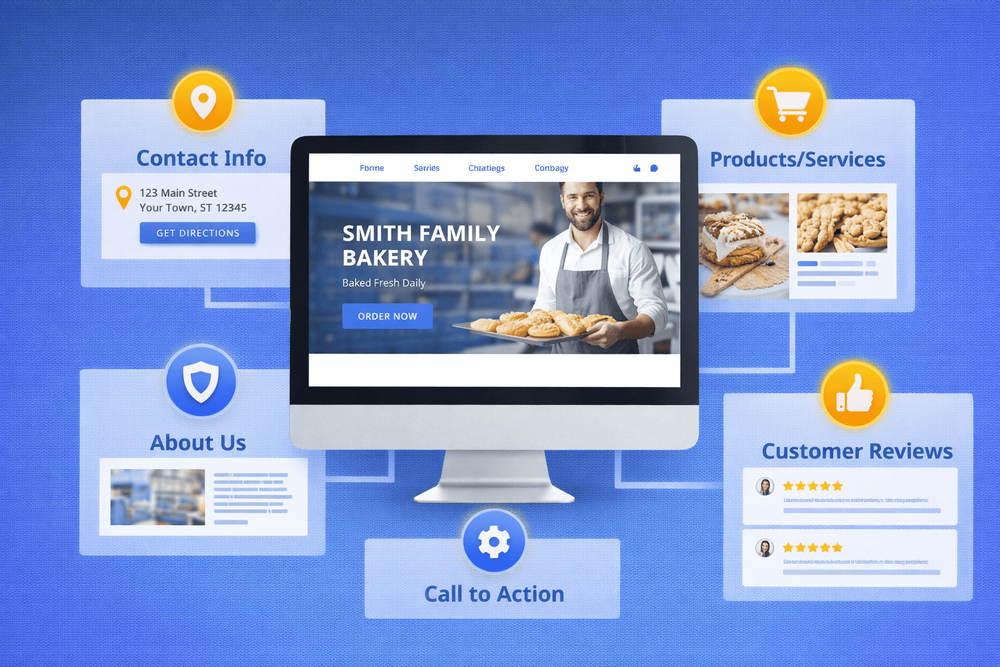
Your contact page should do one thing well: make it as easy as possible for someone to get in touch with you. That means a clickable phone number, an email address, and a simple contact form. If you have a physical location, include your address and an embedded map.
Keep the form short. Name, email, phone number, and a message box - that's enough. Every extra field you add is another reason for someone to give up and go elsewhere. If you need more details, you can ask once they've made contact.
And don't limit your contact information to the Contact page alone. Your phone number and a call-to-action button should appear on every page - ideally in the header where it's always visible. If someone's ready to get in touch, don't make them navigate back to a different page to do it.
Social proof - testimonials or reviews
When a visitor is deciding whether to trust your business, nothing works better than hearing from someone who's already used you. Testimonials and reviews are one of the most powerful things you can put on your website - and one of the most underused.
You don't necessarily need a dedicated testimonials page. Weaving reviews into your homepage, service pages, and About page can be even more effective because visitors see them in context. A testimonial on your plumbing page from someone who hired you for plumbing work is more convincing than a generic "great service" on a separate reviews page.
Use real names wherever possible - a testimonial from "John, Manchester" is more credible than one from "J.M." And if you have Google reviews, link to your Google Business Profile so visitors can see you're genuine. Your website should be your best salesperson - testimonials are how it closes the deal.
What you probably don't need yet
If you're going to start a blog, commit to it. A blog with two posts from 2022 does more harm than no blog at all - it tells visitors nobody's home. If you're not ready to publish regularly, leave the blog for later. Your website can work perfectly well without one. When you are ready, a blog can be a powerful tool for SEO and attracting new visitors - but only if you keep it alive.
Every few months a client asks whether they need a chatbot. For most small businesses, the answer is no - not yet. A clearly visible phone number and a simple contact form will get you more enquiries than a chatbot that gives robotic answers to questions nobody asked. Get the basics right first, then add complexity if it makes sense.
The same goes for features like appointment booking systems, membership areas, or animated homepage sliders. These can all add value in the right context, but they're not where you should start. A clear, fast, mobile-friendly website with the right pages will outperform a feature-packed site that confuses visitors.
Get the foundations right
A small business website doesn't need to be complicated. Five or six well-structured pages - homepage, services, about, contact, and some form of social proof - will do more for your business than a sprawling site that tries to do everything.
The key is making sure each page has a clear purpose and gives the visitor a reason to take the next step. If your site does that, it's working. If it doesn't, it might be time to take a closer look at what's getting in the way. Our guide on how to tell if your website is costing you customers is a good place to start.
Not sure if your website has the right foundations? We'll take a look and give you an honest assessment of what's working and what's missing.
Book a free consultationFAQ
What will you learn in "What Should a Small Business Website Actually Include?"?
A homepage that answers the right question Your homepage is the most visited page on your site. It's where most people land first, and it's where they decide - usually within a few seconds - whether to stay or leave.
Why is A homepage that answers the right question important?
Because it directly affects trust, message clarity, and conversion before someone contacts you.
What is the best first step?
Apply one practical change this week, measure the result, and repeat with the next highest-impact improvement.

Categories: General