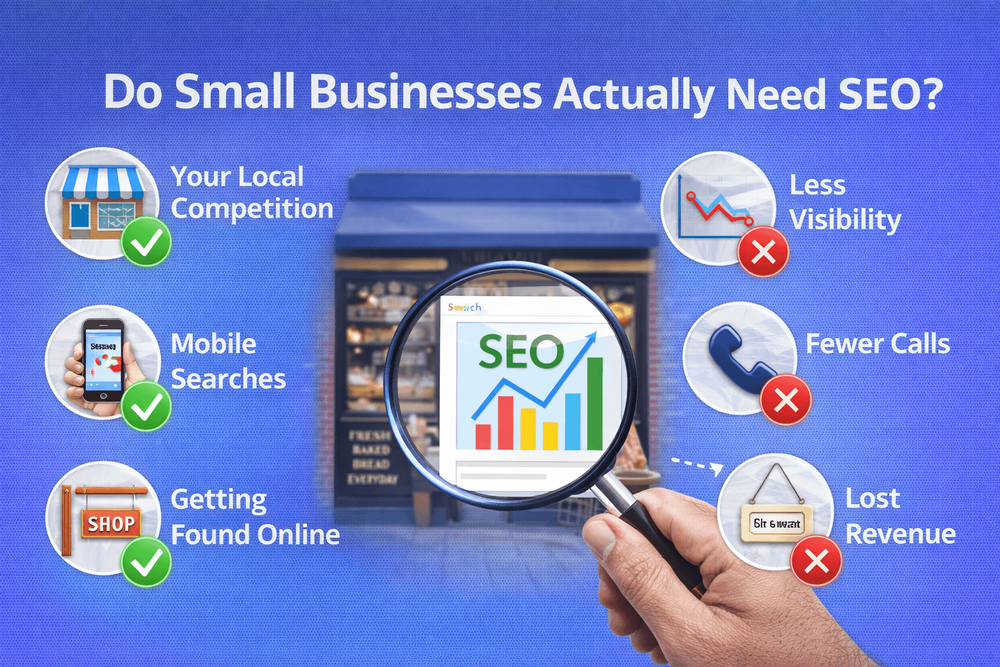
Do Small Businesses Actually Need SEO?
SEO gets thrown around a lot, but what does it actually mean for a small business? Here's an honest look at what matters, what doesn't, and where to start.
Quick answer
What SEO actually means (without the jargon) SEO stands for search engine optimisation. In plain English, it means making your website easy for Google to find, understand, and recommend to people who are searching for...
Key takeaways
- What SEO actually means (without the jargon)
- The short answer - yes, but not how you think
- What SEO looks like for a small business
- The "I'll just run ads instead" trap
What SEO actually means (without the jargon)
SEO stands for search engine optimisation. In plain English, it means making your website easy for Google to find, understand, and recommend to people who are searching for what you offer.
That's it. It's not a dark art. It's not a magic trick. And it's definitely not something you "add on" after your site is built, like a coat of paint.
Good SEO covers things like how your pages are titled, whether your site loads quickly, how well it works on a phone, and whether the content on your pages actually answers the questions your customers are asking. Most of this is just good web design done properly.
The short answer - yes, but not how you think
Your customers are searching online. If your business doesn't show up, someone else's does. Over half of all website traffic comes from organic search, and the vast majority of people never scroll past the first page of Google results.
But here's the part that often gets left out of the sales pitch: SEO isn't a quick fix. It typically takes six to twelve months to see meaningful results, and the strongest returns come in year two and beyond. Anyone promising you first-page rankings in a few weeks is either misleading you or targeting keywords nobody is searching for.
The real value of SEO is that it compounds over time. A well-optimised page can keep bringing in visitors for months or years without any additional cost per click.
What SEO looks like for a small business
You don't need an enterprise keyword strategy or a dedicated marketing team. For most small businesses, effective SEO comes down to a handful of things done well.
We've had clients who ranked well on Google without ever "doing SEO" - because their site was well-built, fast, mobile-friendly, and had clear content that matched what people were searching for. They didn't know they were doing SEO. They just had a site that worked properly. That's the point most people miss - good SEO starts with good web design.
When we do a basic SEO review for new clients, we often find that their site has no meta descriptions set up at all. Every page shows the same default snippet in Google - or worse, a random chunk of text from the middle of the page. It takes ten minutes to fix, and it can make a real difference to how your listing looks in search results.
The fundamentals for a small business look like this: clear page titles that describe what each page is about, a site that loads in under three seconds, content that speaks to your customer's problem rather than just listing your services, a complete Google Business Profile, and a site that works properly on mobile. None of this requires expensive tools or specialist knowledge.
The "I'll just run ads instead" trap
Paid advertising has its place. But relying on ads without a website that's built to convert is a common and expensive mistake.
One of the things we try to explain early on is the difference between renting and owning your traffic. Ads are rent - the moment you stop paying, the traffic disappears. SEO is more like building equity. It takes longer to see results, but once your pages rank, they keep working for you month after month without an ongoing cost per click.
We've talked before about clients who spent heavily on Google Ads without a website that was ready for the traffic. The ads did their job - people clicked. But the site loaded slowly, had no clear call to action, and gave visitors no reason to get in touch. The ad spend was gone. The enquiries never came. If that sounds familiar, our post on 5 things to check before you spend a penny on ads is worth a read.
The smartest approach for most small businesses is to get the website right first, build SEO into the foundations, and then use ads to supplement - not replace - your organic visibility.
When SEO isn't the right priority
We sometimes have to tell clients something they don't want to hear: your website isn't ready for more traffic. If your site doesn't convert the visitors it already gets, sending more people to it won't change anything. It's like pouring water into a bucket with holes. Fix the bucket first, then turn on the tap.
We've seen businesses get excited about ranking on the first page of Google for a local keyword - only to realise it made no difference to their enquiries. The traffic went up, but the phone didn't ring. That's because ranking is only half the equation. What the visitor sees when they land is the other half.
If your website isn't generating enquiries from the traffic it already has, the priority isn't more visibility - it's fixing what's broken. We've written about how to spot those problems in our guide on how to tell if your website is costing you customers. Start there before investing in SEO.
What you can do right now without spending a penny
You don't need to hire an agency to get started. There are a few things you can do today that will make a genuine difference.
The single quickest SEO win for most local businesses is claiming and completing their Google Business Profile. We still come across businesses that either haven't claimed theirs or filled it in with one line and no photos. It's free, it takes half an hour, and it directly affects whether you show up in local map results.
Here's another quick check: search for your business name on Google. What shows up underneath it? If the text doesn't clearly describe what you do and where you do it, your page titles and meta descriptions need work. This is one of the few things in SEO where a small change can have a visible impact relatively quickly.
Beyond that, make sure your site loads fast - you can check for free at PageSpeed Insights. Check that every page has a clear heading that describes what it's about. And if you have images on your site, make sure they have descriptive alt text - it helps Google understand what's on the page, and it makes your site more accessible too.
So, do you actually need SEO?
If your customers search online for the kind of thing you offer - and they almost certainly do - then yes, SEO matters. But it doesn't have to be complicated or expensive to get started.
The best SEO isn't a separate project bolted onto your website after the fact. It's built into the way your site is designed, written, and structured from day one. A website that's fast, clear, mobile-friendly, and speaks directly to your customer's needs is already doing most of the heavy lifting.
If you're not sure whether your website has the basics covered, or you want to understand what's holding it back, we're happy to take a look. Your website should be your best salesperson - SEO is what helps people find the door.
Not sure if your website is set up to be found? We'll review your site and give you an honest assessment - no jargon, no pressure.
Book a free consultationFAQ
What will you learn in "Do Small Businesses Actually Need SEO?"?
What SEO actually means (without the jargon) SEO stands for search engine optimisation. In plain English, it means making your website easy for Google to find, understand, and recommend to people who are searching for...
Why is What SEO actually means (without the jargon) important?
Because it directly affects trust, message clarity, and conversion before someone contacts you.
What is the best first step?
Apply one practical change this week, measure the result, and repeat with the next highest-impact improvement.

Categories: General