What Should a Website Actually Cost - And What Are You Getting for Your Money?
Honest breakdown of small business website costs in the UK - what DIY, freelancers, and agencies actually charge, and what you get for each option.

Quick answer
Most people asking "how much should a website cost?" end up more confused than when they started. Quotes come back ranging from £300 to £30,000, and they're often for what sounds like the same thing.
Key takeaways
- Why website pricing is so confusing
- The four price tiers explained honestly
- £0–£500/year — DIY builders (Wix, Squarespace, GoDaddy, Shopify)
- £800–£3,000 — Freelancer
Most people asking "how much should a website cost?" end up more confused than when they started. Quotes come back ranging from £300 to £30,000, and they're often for what sounds like the same thing.
That's because the question is wrong. The real question isn't how much. It's what are you getting for your money? A £300 website and a £6,000 website aren't the same product at a different price — they're different products entirely.
This is an honest breakdown of what's actually on offer at each price point in the UK, and how to know what you actually need.
Why website pricing is so confusing
We had a prospect once who'd been quoted three prices for a small business website: £299, £1,800, and £8,500. All for what sounded like the same thing — "a five-page website with a contact form." We looked at the £299 quote and it was a template-based site, 95% outsourced, locked to a platform she'd never heard of. The £8,500 quote was a full discovery and strategy project from a London agency. None of them were wrong for what they were. They were just wildly different products wearing the same name.
The word "website" is doing a lot of heavy lifting, and most of the confusion about pricing comes from that. When one agency says "a website" they mean two weeks of strategy, copywriting, custom design, and a proper build. When a freelancer on a marketplace says "a website" they mean 90 minutes with a Wix template. Both quotes are technically honest. The problem is that if you compare prices without understanding what each one actually includes, you're comparing apples to spare parts.
Before you compare prices, understand what's being priced.
The four price tiers explained honestly
£0–£500/year — DIY builders (Wix, Squarespace, GoDaddy, Shopify)
- What you get: A templated site you build yourself. Hosting, a basic domain, and an editor that lets you drag things around.
- What you don't get: Custom design, strategy, SEO foundation, copywriting help, or anyone to call when something breaks.
- Hidden costs: Your time (most people spend 20–40 hours on their first DIY site), upgrades for things you'll need later (business email, premium features, remove-branding), and platform lock-in — if you want to leave Wix or Squarespace, you're largely rebuilding from scratch.
- Right for: Very early-stage businesses, personal brands, hobby projects, or a tradesperson who just needs "something basic online" so they look legit.
£800–£3,000 — Freelancer
- What you get: A small custom build, usually in WordPress or a page builder, with some level of personalisation to your business.
- Quality varies massively — from excellent to terrible. Some freelancers are genuinely skilled and a brilliant value; others are essentially selling the same template with your logo dropped on top.
- Watch for: Work that's been outsourced overseas without you knowing, projects that get abandoned halfway through, no clear ongoing support after launch, and no discovery phase before the design starts.
- Right for: Small businesses that need something solid, have a clear brief, and can vet the freelancer properly before committing.
£2,500–£6,000 — Small agency (where most UK SMEs land)
What you get: Strategy and discovery before design starts, custom design that reflects your business, a proper build, help with copywriting, and post-launch support.
You're paying for process, not just code. The agency is asking who your customers are, what decisions they make, and designing the site to move those decisions along.
Right for: Businesses that are serious about the website driving enquiries and revenue, not just "being there."
£6,000–£20,000+ — Larger agency or complex build
What you get: Ecommerce, custom integrations, multi-site setups, brand work, or highly specialised requirements. More project management, larger teams, longer timelines.
Right for: Businesses with specific commercial goals that genuinely justify the spend — e.g. ecommerce operations, complex service businesses with booking/membership needs, or agencies with their own clients who need a premium presentation.
If you're a small service business with a simple offer, you almost certainly don't need this tier.
What you're actually paying for (no matter the tier)
The parts of a website that cost the least to build are the parts you see. Colours, layout, fonts, the logo placement — that's an afternoon's work if the foundation is right. What actually takes time is everything you don't see on the finished page: working out who the site is for, writing copy that speaks to them, structuring it so Google can find it, and making sure it loads fast on a three-year-old Android. When a website is cheap, the strategy and the copywriting are almost always where the cuts were made.
A useful way to think about it: a website is a bit like hiring someone. A cheap website is like hiring someone who turns up, looks the part, and does the bare minimum. A properly built website is like hiring someone who understands the job, asks the right questions, and shows up ready to bring in business. Both technically show up every day. Only one actually earns their keep.
Broadly, what any proper website project involves:
- Strategy and discovery — who the site is for, what it needs to do, what success looks like
- Design — information architecture (the logic of the site) and visual design (the look)
- Copywriting — the hardest part, and usually the most undervalued
- Build — turning design into a working website
- SEO foundation — structure, speed, meta, schema, image optimisation
- Post-launch — hosting, maintenance, updates, fixes
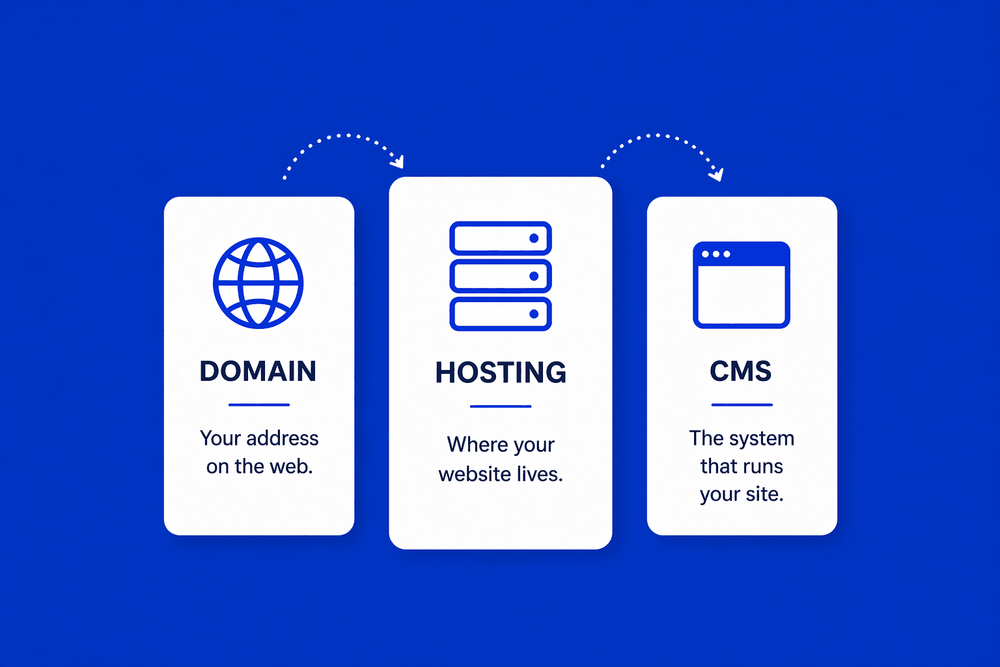
Cheap websites cut corners on strategy, copywriting, and SEO foundation. Those are exactly the areas where the value actually lives. For a deeper look at what you're paying for on the infrastructure side, our guide on domain, hosting, CMS — what you're actually paying for breaks it down piece by piece.
The hidden costs nobody mentions
Your own time
The cost most people forget to include is their own time. Building your own site on a DIY builder sounds like saving money — until you've lost three weekends to wrestling with templates, four evenings fighting with a contact form that won't send, and a Saturday morning watching YouTube tutorials on SEO. For most business owners, that time is worth more than the difference between DIY and hiring someone. You've just paid for your website — in hours you could have been earning.
The cost of a website that doesn't work
The bigger hidden cost is the website that doesn't do its job. A cheap site that loses you one decent enquiry a month is costing you far more than it saved you upfront. We've seen tradesmen on £299 websites who were losing £2,000-plus jobs every month because the site loaded slowly on mobile and had no clear way to get in touch. They "saved" a couple of thousand on the build and were losing it five times over every year. That's the real cost of building cheap.
The ongoing bits
Even after launch, a website isn't a one-time expense. Rough annual running costs for a small business site:
- Domain: £10–£30/year (.co.uk is cheaper than .com)
- Hosting: £5–£30/month depending on site complexity
- Business email: £3–£10/month per address (Google Workspace, Microsoft 365)
- Maintenance: £30–£200/month if you want someone keeping it updated, secure, and working
Most small businesses should budget £500–£2,000/year for running costs depending on what the site does.
The real question — what's the ROI?
Here's the number that actually matters. If your website brings you one extra £5,000 client per year, a £3,000 website has paid for itself in the first project — and every subsequent enquiry is pure return on that investment. Over three years, the maths on a properly built small business website is usually obvious.
The right question isn't "can I afford £3,000 for a website?" It's "what will this website bring me that my current situation isn't?"
If your current site is bringing in zero enquiries, the cost of not changing it is the opportunity cost of every enquiry you're not getting. That's often a much bigger number than the build cost.
Red flags at every price tier
Regardless of the price you're being quoted, these are warning signs:
- Anyone promising "complete websites for £299" — it's a template, probably outsourced, with a platform lock-in that will cost you later
- No discovery phase, no questions about your business, no interest in your customers
- 100% payment required upfront before any work starts
- Vague quotes with no line items explaining what's included
- No discussion of what happens after the site launches
- Guarantees about Google rankings or traffic numbers — nobody can guarantee these honestly
- Complete unwillingness to explain what platform the site will be built on, or who actually owns the domain and hosting after launch
What we charge (honestly)
For what it's worth, we tell prospective clients the same thing we'll tell you: if your budget is genuinely under £1,000, a DIY builder is probably the honest answer and we'll say so. If you need ecommerce with 500 products and complex integrations, we'll recommend someone better suited for that.
For the majority of small service businesses between those two extremes, a few thousand pounds properly spent on a site that actually brings in enquiries is usually the best investment the business will make that year.
How we keep our pricing where it is
A fair question to ask any agency in the £2,500–£6,000 range is: how can you charge less than the bigger agencies and still build something proper? It's worth answering honestly — because how an agency keeps its prices down matters as much as the price itself.
Three things make it work for us:
We build with our own custom components, not templates. When most agencies say "custom build," they mean a heavily-modified template. When the cheaper end of the market says "custom build," they mean a barely-modified template. We've spent years building our own library of reusable elements — headers, sections, forms, layouts — that we own outright and adapt for each client. Each site is genuinely tailored to the business, but we're not reinventing the wheel every time we start a new project. That's how the costs stay sensible without cutting corners on the actual build.
We work with a carefully chosen distributed team. We don't carry the overhead of a big city office or a layered project-management hierarchy. We work with specialists we've vetted carefully and worked with for years — designers, developers, specialists in particular tools. That keeps our running costs lower than a typical agency, and it means we pass the savings on rather than charging you for office space you'll never see.
We use AI where it helps, and not where it doesn't. AI tools genuinely speed up parts of the work — initial research, repetitive technical setup, certain QA tasks. We use them for that. We don't use them to write the strategy, design the site, or write the copy that goes on it — because AI can't fix a bad brief, and a website written by AI without a human steering it ends up sounding like every other site written by AI. The judgement bit is still ours.
These are some of the operational decisions that let us keep prices where small businesses can actually afford them — without cutting the work that matters. There are other parts of how we run things that we keep to ourselves, because they're genuinely part of what makes us competitive. But none of these three are shortcuts. They're the difference between an agency that charges what it charges because the building is expensive, and one that charges what it charges because the work is.
The bottom line
Website pricing isn't as confusing as it looks once you understand what's actually being priced. A £299 site and a £6,000 site aren't competing products — they're solving different problems.
Before you accept the cheapest quote, ask yourself what that quote is missing. Before you accept the most expensive, ask what you're paying extra for. The right price for you is whichever tier honestly matches what your business needs the website to do — no more, no less.
If you'd like a genuine view of what tier your business actually needs, that's exactly the kind of conversation we have in a free consultation. We'll tell you honestly — including if the honest answer is "you don't need us yet."
Not sure what tier of website your business actually needs? Book a free consultation. We'll give you a straight answer — even if the answer is that you don't need us yet.
Book a ConsultationFAQ
What will you learn in "What Should a Website Actually Cost - And What Are You Getting for Your Money?"?
Most people asking "how much should a website cost?" end up more confused than when they started. Quotes come back ranging from £300 to £30,000, and they're often for what sounds like the same thing.
Why is Why website pricing is so confusing important?
Because it directly affects trust, message clarity, and conversion before someone contacts you.
What is the best first step?
Apply one practical change this week, measure the result, and repeat with the next highest-impact improvement.

Categories: Planning and costs