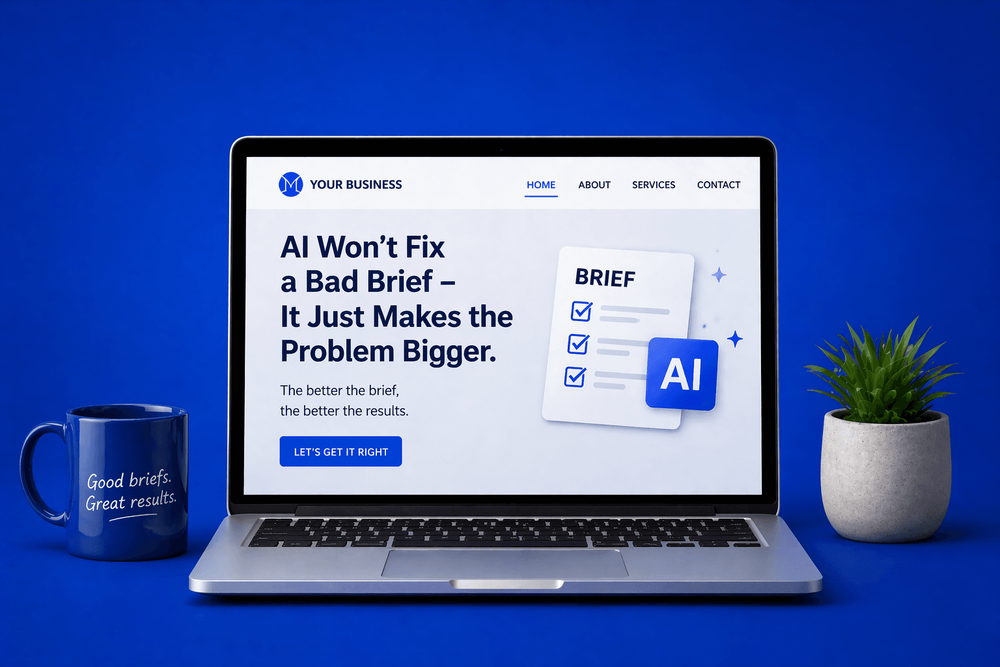
AI Won't Fix a Bad Brief - It Just Makes the Problem Bigger
AI web design tools are impressive - until you give them a bad brief. Here's what actually happens when businesses skip the strategy and go straight to the tools.
Quick answer
The site looks finished. But it doesn't bring enquiries. And no one knows why. AI web design tools are impressive - until you give them a bad brief. Here's what actually happens when businesses skip the strategy and go...
Key takeaways
- What AI tools are actually good at
- Why AI websites end up looking the same
- The snowball problem
- Cheap now, expensive later
The site looks finished. It's live. But it doesn't bring enquiries. It doesn't convert. And no one knows why.
That's the situation we hear about more and more - businesses that used an AI tool to build or redesign their website, felt good about it at the time, and are now quietly wondering why nothing has changed. The tool did its job. The problem is the job it was given wasn't the right one.
AI makes a good brief better and a bad brief worse. Fast. And the dangerous part is most businesses don't realise it's failing until weeks or months have passed.
Most AI websites don't fail because of the tool. They fail because no one made the important decisions first.
What AI tools are actually good at
We use AI tools in our own workflow. We want to say that upfront because this isn't an anti-AI post. These tools are genuinely useful - they've made parts of our process faster and given small businesses access to things that used to cost a lot more. But useful and sufficient are two different things, and that distinction matters a lot when it's your business on the line.
AI is excellent at production. Layouts, copy scaffolding, image generation, code - it handles the pattern-based work well and handles it fast. If you know what you want and can describe it clearly, AI tools can get you there quicker than ever before.
But there's a crucial distinction that gets lost in most of the conversation around AI web design: looking finished and performing well are two very different things.
What AI can't do
The problem we keep seeing isn't that AI tools are bad. It's that they're being used to skip a step that can't be skipped. You can't prompt your way to a clear business strategy. You can't generate your way to understanding what your customers actually need. And when those things are missing, AI just produces the wrong thing faster.
AI doesn't know what your customer is worried about before they contact you. It doesn't know what makes you different from the business next door. It doesn't know what objections your visitors have, what reassurance they need, or what would make them pick up the phone.
So it fills those gaps with generic answers. And generic websites don't convert. Wrong messaging means no trust. Wrong structure means confusion. The wrong audience assumed means no leads - even if the site looks the part.
Why AI websites end up looking the same
There's another problem that doesn't get talked about enough: AI doesn't invent positioning. It averages it.
These tools are trained on existing websites. They've learned what websites tend to look like, how copy tends to sound, what layouts tend to be used. So when you ask them to build something, they produce a confident-looking average of everything they've seen before.
The result is a site that looks professional at a glance but feels like everyone else's. No real differentiation. No distinctive voice. No clear reason for a visitor to choose you over the next result on Google. It's not that it's bad - it's that it's indistinct. And indistinct doesn't convert either.
The snowball problem
We've been brought in to fix sites that started this way. By the time we see them, they've been through six rounds of changes and nobody can remember what the original intention was. The homepage says one thing, the services page says another, and the contact form asks for information the business doesn't actually need. It looks like a website. It just doesn't work like one.
The thing about AI-generated sites that haven't been thought through properly is that the problems are invisible at first. The site looks finished. It's live. Then a month passes and there are no enquiries. So something gets changed. Then something else. Each change introduces a new inconsistency. Six weeks later you've got a site that nobody fully understands - including the person who owns the business.
At that point the problem isn't the website anymore. It's that no one trusts it enough to invest in fixing it properly. So it limps on, doing nothing, quietly costing the business customers it never even knew it was losing.
Cheap now, expensive later
AI tools lower the upfront cost of getting a website live. That's real and it matters. But they don't remove the cost of doing it properly - they postpone it.
A site that looks finished but doesn't convert still needs to be fixed. And fixing a site that's been through multiple rounds of unclear changes is often harder and more expensive than building something right from the start. The shortcuts taken early become constraints later.
Most AI websites don't save money. They just delay the real investment - until the business has already felt the impact of not having something that works.
The brief is the product
We had a client come to us after spending three months going back and forth with an AI builder. The site looked fine. But when we asked them who their ideal customer was, they gave us three different answers in the same conversation. That was the real problem - and no amount of redesigning was going to fix it until we'd worked that out first.
Every website we build starts with the same questions. Who is this for? What problem does it solve for them? What do we want them to do when they land on it? What makes this business different from the one next door?
Those aren't design questions. They're business questions. And until you can answer them clearly, no tool - AI or otherwise - can build you something that works.
AI can build the house. The brief decides where the doors go - and whether anyone can find them.
One thing AI definitely won't sort out for you
While we're here: AI can generate a privacy policy. That doesn't mean your website is compliant.
If your site has a contact form, a mailing list, or analytics tracking - which most do - you have legal obligations around how that data is collected and used. An AI tool will produce text that looks like compliance. Whether it actually reflects your specific setup, your data practices, and the current UK GDPR requirements is a different question entirely.
We've written a full guide to what your website actually needs to comply with GDPR if you want the detail - but the short version is: this is one area where generated content isn't a substitute for getting it right.
How we use AI in our own work
We use AI to move faster once the thinking is done. It helps us generate layout options, draft copy structures, and speed up parts of the build. But it doesn't make a single strategic decision. That's still us - working with the client, understanding the business, making judgement calls that a language model isn't equipped to make.
The businesses getting the best results from AI right now aren't the ones who used it first. They're the ones who did the thinking first - who knew what they needed, who they were talking to, and what they wanted people to do. Once you have that clarity, AI is a brilliant tool. Without it, you're just producing the wrong thing faster.
We use AI to move faster. We don't let it decide.
Thinking first, tools second
If your website isn't bringing in enquiries, the answer probably isn't a new tool. It's clarity - about your customer, your offer, and what you want your website to actually do.
No AI tool can give you that. But once you have it, everything else - including the AI - works a lot better.
If you're not sure where your website is going wrong, we're happy to take a look. Our first consultation is free, and we'll give you a straight answer about what's actually holding it back.
Not sure why your website isn't converting? We'll review it and tell you what's actually holding it back - no jargon, no sales pitch, just honest advice.
Book a ConsultationFAQ
What will you learn in "AI Won't Fix a Bad Brief - It Just Makes the Problem Bigger"?
The site looks finished. But it doesn't bring enquiries. And no one knows why. AI web design tools are impressive - until you give them a bad brief. Here's what actually happens when businesses skip the strategy and go...
Why is What AI tools are actually good at important?
Because it directly affects trust, message clarity, and conversion before someone contacts you.
What is the best first step?
Apply one practical change this week, measure the result, and repeat with the next highest-impact improvement.

Categories: Web design