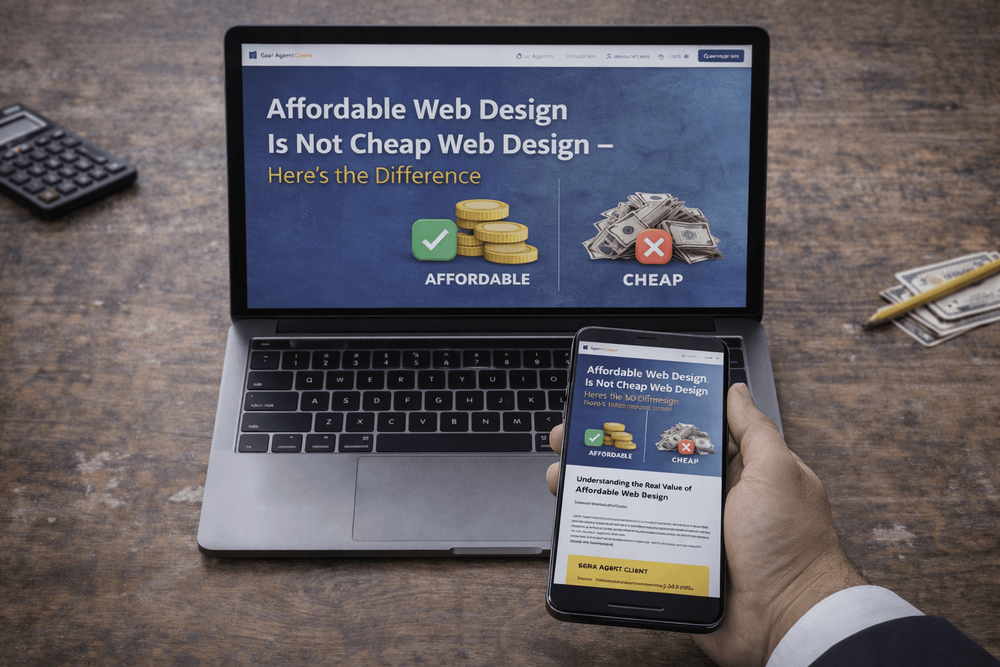
Affordable Web Design Is Not Cheap Web Design - Here's the Difference
There's a word that causes more confusion in web design than any other: affordable.
Quick answer
There's a word that causes more confusion in web design than any other: affordable. Some people hear it and think "bargain." Others hear it and think "basic." Neither is right.
Key takeaways
- What "Cheap" Web Design Actually Looks Like
- What "Affordable" Actually Means
- Why Price Gets Confused With Quality
- What You Should Actually Be Paying For
There's a word that causes more confusion in web design than any other: affordable.
Some people hear it and think "bargain." Others hear it and think "basic." Neither is right. Affordable web design and cheap web design look similar on paper - they both cost less than a traditional agency. But they deliver completely different results.
Most small business owners think they have two options: do it themselves for next to nothing, or hire an agency for thousands. But there's a middle ground that most people don't know exists - professional web design that's built on smart systems and efficient processes, delivered at a price that doesn't require a business loan. That's the space we occupy. Not the cheapest. Not the most expensive. The smartest value for what you actually need.
The web design market has a gap in the middle. On one side, you've got DIY tools and low-cost freelancers who give you pages but no strategy. On the other, agencies charging five figures because of overhead, account managers, and office space you're indirectly paying for. We exist in the gap. We keep costs accessible by being efficient, not by cutting corners. And we include the thinking that cheap options skip - because a website without strategy is just a website that doesn't work.
This post explains the difference, why it matters, and how to tell which one you're actually getting.
What "Cheap" Web Design Actually Looks Like
Cheap web design isn't always obvious at first. The site might look fine. The colours match, there's a logo at the top, the pages load. But under the surface, the things that actually make a website work are missing.
- A template with your logo dropped in. No thought about your business, your customers, or what makes you different.
- No strategy or structure. Pages exist, but there's no logic behind what goes where or how a visitor should move through the site.
- "Just send us your text and images." No content guidance, no help with messaging, no direction on what to say or how to say it.
- No SEO foundation. No keyword thinking, no meta descriptions, no local search setup.
- Fast turnaround because there's no thinking involved. The speed isn't efficiency - it's shortcuts.
We've lost count of how many times someone has said "I tried doing it myself on Wix first." They spent weeks on it, got frustrated, launched something that looked OK, and then wondered why nobody was getting in touch. The issue is never the platform - it's the lack of strategy behind it. A website without direction is just a digital leaflet that nobody picks up.
The worst case we've seen was a small business owner who'd paid a very low-cost freelancer for a website, received something that was essentially a template with their logo dropped in, and then spent the next six months wondering why their phone wasn't ringing. By the time they came to us, they'd spent more in total - the original build plus the rebuild - than if they'd invested in something proper from the start.
What "Affordable" Actually Means
Affordable doesn't mean less. It means smarter, more efficient delivery of high-value work.
When we say affordable, we mean the cost is lower because our process is more efficient - not because we do less work. We've built systems that reduce wasted time, standardise the parts that don't need reinventing, and focus effort on the things that actually drive results for your business.
- Strategy and structure included. We don't start with design - we start with thinking. What pages do you need? What should each page say? What action should visitors take?
- Marketing-first approach. Not just how it looks, but what message attracts the right customers and what builds trust.
- Content guidance. We help shape your headlines, sections, and positioning. We don't just hand over a blank template and say "fill it in."
- Conversion focus. The site should generate enquiries and support business growth - not just exist online.
- A clear, defined process. Defined steps, no chaos, no surprises. You know what you're getting and when.
We price our work to be accessible because we believe good websites shouldn't be a luxury. But accessible pricing puts you in an awkward spot. You're too expensive for people who want the cheapest option, and too affordable for people who assume quality means high cost. The truth is, our pricing is lower because our process is more efficient - not because we do less work. We've built systems that let us deliver strategic, well-structured websites without the overhead that pushes agency prices into the thousands.
Why Price Gets Confused With Quality
Here's something we've learned the hard way: when you offer a lower price, some people assume lower quality. They don't see the systems and thinking behind the work - they just see a number and compare it to someone charging three times more.
The real value of a website - the planning, the structure, the strategy - is invisible in the final product. All the customer sees is pages on a screen. The thinking that made those pages work is hidden.
This is why so many people end up disappointed after choosing the cheapest option. They compare two websites side by side - one that cost a few hundred pounds and one that cost a few thousand - and they look roughly similar. So they go with the cheaper one. Six months later, one website is generating enquiries. The other is sitting there doing nothing. The difference was never the design. It was the direction behind it.
Most businesses don't need an expensive, overbuilt website. But they also shouldn't settle for something that doesn't work. The goal is a website that's built with purpose - and that doesn't have to cost a fortune.
What You Should Actually Be Paying For
When you invest in a website, the price should cover more than just pages on a screen. Here's what actually makes the difference:
- Structure before design. We always start with structure, not design. What pages do you actually need? What should each page say? How should a visitor move through the site? What action do you want them to take? These questions might sound simple, but most cheap website services never ask them. They jump straight to colours and fonts while the foundations are missing.
- Content guidance. When we build a website, the price includes help with headlines, sections, and positioning. We don't just hand over a blank template and say "fill it in." That's one of the biggest differences, and it's one clients only appreciate after they've experienced the alternative. Trying to write your own website content without guidance is like trying to wire your own house without a plan. You might get something that works, but probably not something that works well.
- Marketing-first thinking. Not just "how does it look?" but "what message connects with your customers and makes them want to get in touch?"
- Conversion focus. Every page should have a purpose. Every section should move the visitor closer to picking up the phone or filling in the form.
- SEO foundations. Keywords, meta descriptions, local search setup - built in from day one, not bolted on as an afterthought.
How to Tell the Difference Before You Buy
If you're comparing web designers, these questions will help you spot the difference between affordable and cheap before you commit:
- "What's your process?" If they can't explain it clearly, that's a red flag. A good process means fewer surprises, less wasted time, and a better result.
- "What's included beyond design?" Ask about strategy, content guidance, and SEO. If the answer is "just the design," you're paying for decoration, not direction.
- "What happens after launch?" Does the support stop the day the site goes live? Or is there ongoing help when you need it?
- "Can I see examples of results, not just designs?" A pretty portfolio is nice, but what you really want to know is: did those websites actually generate business?
- "How do you handle changes and revisions?" If there's no structure around this, you'll either get unlimited rounds of chaos or an unexpected invoice. Neither is good.
What to Do Next
The right website is an investment that pays for itself. Not because it costs a lot - but because it's built with purpose, strategy, and the kind of thinking that turns visitors into customers.
If you've been burned by a cheap website that didn't deliver, or overwhelmed by agency quotes that felt out of reach, there's a middle ground. That's exactly where we work.
Want a website that's built with strategy, not just design?
Book a free consultation and we'll show you what an affordable, well-built website could do for your business.
FAQ
What will you learn in "Affordable Web Design Is Not Cheap Web Design - Here's the Difference"?
There's a word that causes more confusion in web design than any other: affordable. Some people hear it and think "bargain." Others hear it and think "basic." Neither is right.
Why is What "Cheap" Web Design Actually Looks Like important?
Because it directly affects trust, message clarity, and conversion before someone contacts you.
What is the best first step?
Apply one practical change this week, measure the result, and repeat with the next highest-impact improvement.

Categories: General